Water-Damaged Flooring: When to Repair vs When to Replace
Not all water damage means new floors. Learn how to assess the severity, when patching is enough, and when full replacement is the only safe option.
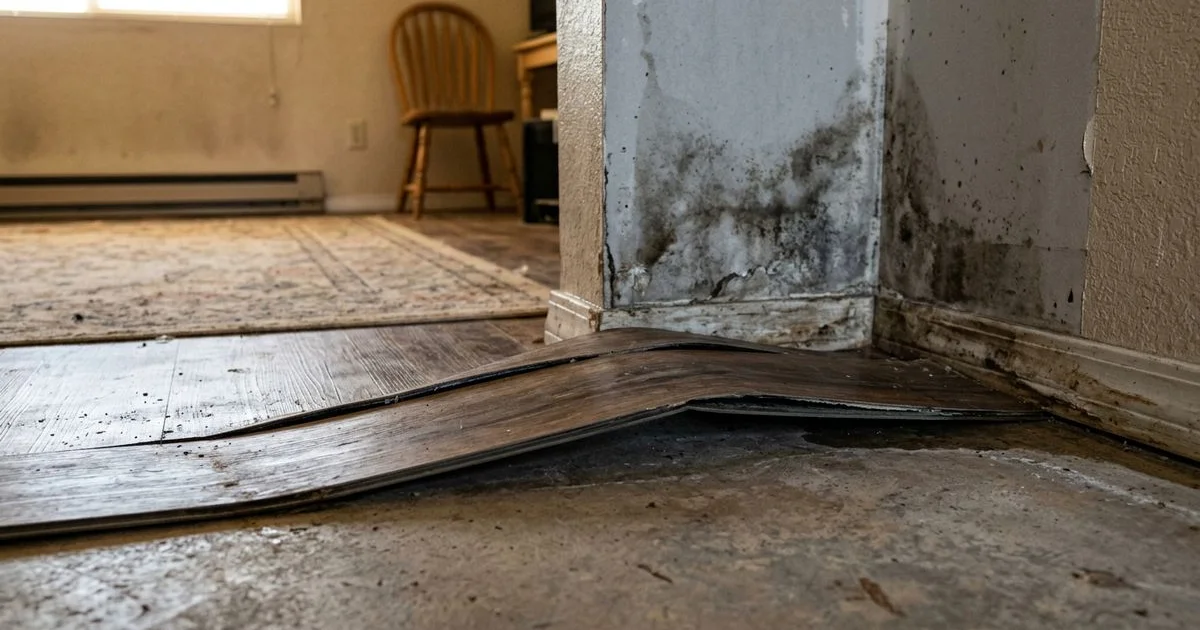
We see it every week across the US. A slow plumbing leak or an overflowing washing machine turns a beautiful room into an incredibly stressful situation.
Water-damaged flooring: when to repair vs when to replace is the urgent question on every homeowner’s mind. Figuring out the right move depends entirely on the material, the timeline, and what is happening underneath the surface. Our flooring installation team handles both scenarios every week.
Let’s look at the actual data, what it tells us about structural safety, and explore a few practical ways to respond effectively.
How to Assess the Damage
Step 1: Stop the Water Source
Before evaluating the floor, you must completely stop the water intrusion. We always recommend locating your home’s main shutoff valve long before an emergency happens.
The Environmental Protection Agency notes that household leaks can waste nearly 10,000 gallons of water annually, and a burst supply line adds rapidly to that total in minutes. Turning off the specific supply valve for a leaking toilet or sink is your fastest first line of defense.
Step 2: Remove Standing Water
Extracting standing water quickly makes a massive difference in saving your floors. Every single hour that water sits, it penetrates much deeper into the building materials.
- First 24 hours: Water stays mostly on the surface. You can often save the floor using a heavy-duty wet vacuum like a 16-gallon Shop-Vac.
- 24 to 48 hours: Water reaches the subfloor. The Federal Emergency Management Agency warns that hazardous mold can begin growing on damp surfaces within this exact window.
- 48+ hours: Subfloor saturation occurs. You are likely facing active mold growth and permanent structural weakening.
We advise using commercial-grade drying equipment if possible. Air movement helps tremendously in dry regions, so position high-velocity air movers like the Dri-Eaz Velo directly across the affected area.
Step 3: Evaluate the Flooring Material
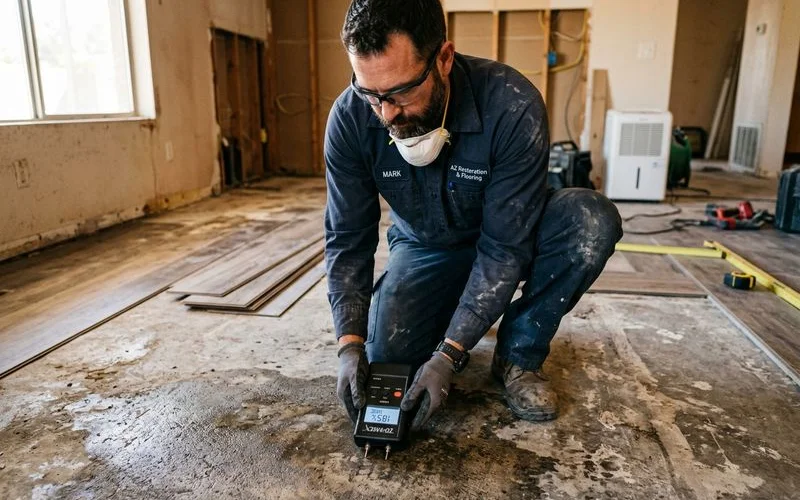
Each flooring type responds to moisture differently. Our team heavily relies on pinless moisture meters, specifically the Wagner Orion series, to scan beneath the surface without damaging the visible planks.
This non-invasive technology gives a crystal-clear picture of whether a localized repair is actually viable.
Repair vs. Replace by Flooring Type
Laminate
Repairing standard laminate is rarely possible after a deep soaking. Laminate relies on a high-density fiberboard (HDF) core that naturally absorbs water like a sponge.
| Water Exposure Condition | Recommended Action |
|---|---|
| Spill wiped up within 1 hour | Swap 1-2 edge planks if available |
| Planks show visible edge swelling | Replace affected area plus a safety margin |
| Appliance leak over multiple hours | Full room replacement |
We often find that replacing the entire room is significantly more cost-effective than attempting a complicated patch job. Finding matching replacement planks from the exact same manufacturing dye lot is incredibly difficult a year or two after the initial installation. Swollen laminate will show permanent bumps at the seams and simply will not flatten out.
Luxury Vinyl Plank (LVP)
You have a much better chance of saving Luxury Vinyl Plank. Premium brands like COREtec feature completely waterproof cores that easily withstand direct water exposure.
Our primary concern is always what is happening beneath those durable planks. If water sat under the LVP for an extended period, mold might be thriving on the hidden subfloor.
You can carefully disassemble the click-lock rows to dry the subfloor and thoroughly inspect the underlayment. We look for three specific conditions to ensure a safe reinstallation:
- Zero visible warping on the plank edges
- A completely clean, mold-free underlayment
- Subfloor moisture readings matching the dry areas of the house
Reinstalling the exact same planks works perfectly when these three conditions are met.
Hardwood
Saving natural hardwood requires patience and strict adherence to National Wood Flooring Association (NWFA) guidelines. The wood’s response depends heavily on the specific species, the finish type, and the duration of the leak.
We check the moisture content to see if it falls within the acceptable 2 to 4 percent variance from the subfloor. Mild cupping, where the edges raise slightly higher than the center, can sometimes flatten naturally over several weeks using slow, controlled dehumidification.
You must completely rip out and replace sections that are severely buckled or blackened by rot. Matching the exact patina and tight grain of an older oak or maple floor with brand-new boards takes a highly skilled finishing professional.
Tile
Ceramic and porcelain tiles are practically impervious to water damage. The real failure points are the porous grout lines and the underlying mortar bed.
Our restoration process usually leaves firmly bonded tiles completely alone. The Tile Council of North America notes that intact waterproofing membranes, like the Schluter-Ditra system, prevent topical water from ever reaching the vulnerable subfloor.
You will know it is time to replace the floor if the tiles sound distinctly hollow when tapped with a tool. A hollow sound means the standing water has compromised the thin-set mortar bond, requiring complete removal to properly dry the structure below.
Carpet
Carpet replacements are mandatory in almost all major flooding scenarios. The thick pad underneath acts as a giant sponge, trapping moisture and creating an ideal environment for dangerous bacteria.
We strictly follow the Institute of Inspection, Cleaning and Restoration Certification (IICRC) safety standards. Their S500 guidelines explicitly state that any carpet touched by Category 3 “black water” from sewers or external ground flooding must be discarded immediately.
A tiny, clean-water spill caught within minutes is the only real exception. Most homeowners simply do not spot the leak fast enough to save the completely saturated padding.
The Subfloor Is the Real Question
Concrete Slab Subfloors
Concrete absorbs water slowly but releases it at an agonizingly slow pace. A concrete slab can easily retain elevated moisture for weeks after a major pipe burst.
- Trapped moisture rapidly breaks down new flooring adhesives.
- High humidity readings will void most manufacturer warranties.
- Organic dust between the slab and floor fuels rapid mold growth.
We mandate an ASTM F2170 relative humidity test before clearing any space for new installation. Most major US flooring manufacturers require the concrete to read below 75 percent relative humidity. Professional drying significantly speeds up this process, but a fully saturated slab requires time to cure safely.
Plywood and OSB Subfloors
Wooden subfloors are highly vulnerable to permanent structural degradation. The Engineered Wood Association clearly advises that prolonged moisture exposure above 20 percent inevitably leads to destructive wood rot.
You will quickly notice delamination, severe swelling, and a spongy feel underfoot. We consider cutting out and replacing soft, damaged sections of oriented strand board (OSB) or plywood to be an absolute requirement. Installing fresh, beautiful flooring over a compromised wooden base simply guarantees a costly failure down the road.
Working with Insurance
Homeowners insurance often covers the heavy financial lift of sudden water emergencies. A 2026 update from the Insurance Information Institute indicates the average US water damage claim now exceeds $12,500.
We recommend reviewing your standard ISO HO-3 policy language to fully understand your specific coverage limits. Sudden events like a ruptured washing machine line are usually covered, while gradual, long-term seepage is routinely denied.
- Document everything: Take clear video and hundreds of photos before cleaning anything up.
- Call your provider: Contact your insurance agent within the first critical 24 hours.
- Demand a professional assessment: Secure a detailed written evaluation to support your financial claim.
- Save the evidence: Keep damaged materials on-site until the field adjuster physically inspects them.
- Track your expenses: Hold onto every single receipt for emergency fan rentals or wet vacs.
Next Steps After Water Damage
Time is your biggest enemy after a flood. The longer you wait to extract the moisture, the more extensive and expensive the necessary repairs quickly become.
We provide rapid, honest evaluations for water-damaged floor replacement to figure out exactly what can be saved and what must be torn out. Testing the hidden moisture levels gives you a clear, data-driven path forward for restoring your home.
Contact us for an assessment or call 480-428-5080.

Thomas Inman
Owner, Zona Floors
Thomas Inman founded Zona Floors in 2022 with a mission to bring honest pricing and quality craftsmanship to homeowners across Maricopa County.
Arizona ROC License #336899 · Thumbtack Top Pro 2023–2025
Looking for professional help?
Learn about our Flooring Installation service →