Quartz vs Granite Countertops: Which Is Better for Arizona Kitchens?
Quartz is engineered for consistency while granite offers natural beauty. Compare maintenance, heat resistance, cost, and durability for Arizona homeowners.
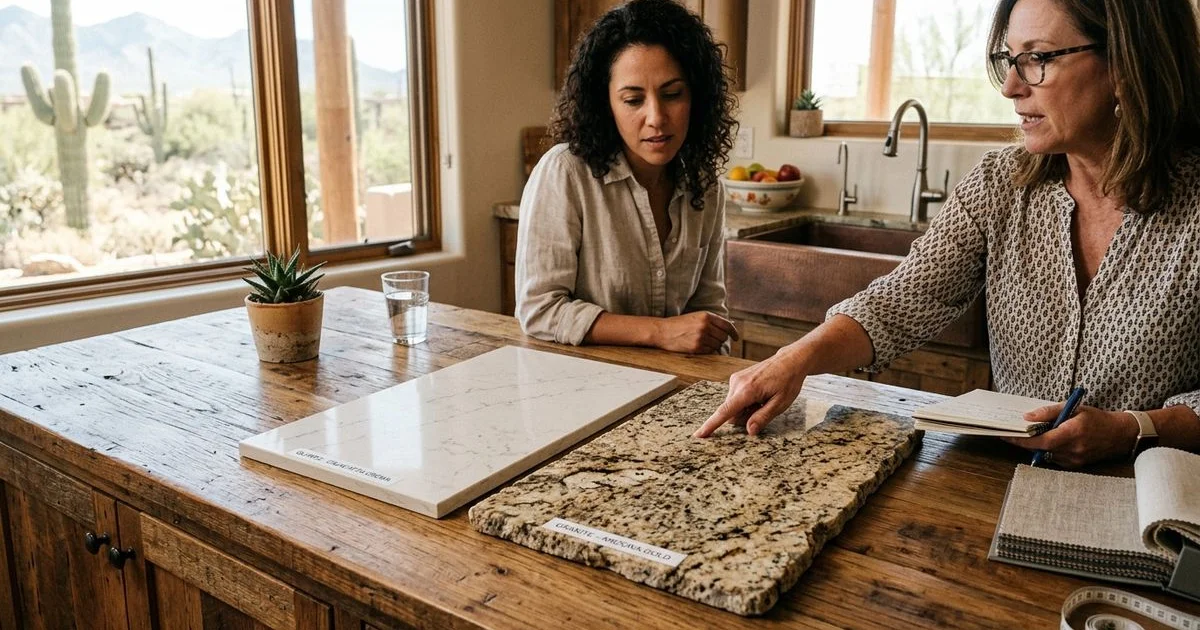
We frequently see homeowners struggle with the same massive question during a remodel: quartz vs granite countertops: which is better for Arizona kitchens? This choice sets the tone for your entire kitchen flooring project. Our team notices that these two premium materials dominate the Phoenix metro market because they deliver incredible value.
From what we have seen, the right choice actually depends entirely on your specific cooking habits and daily lifestyle.
We will break down the exact performance data for both stones to help you make a confident decision. This analysis covers practical details on heat thresholds, maintenance costs, and regional factors.
What They Are
We always start by explaining the fundamental physical differences between these two surfaces. Granite is a natural stone quarried directly from the earth in massive blocks. Each slab contains unique mineral compositions of feldspar and mica. Fabricators cut the stone to size before polishing and sealing it for your home.
Our clients often ask how engineered stone differs. Quartz surfaces, including popular 2026 US-manufactured brands like Cambria, consist of roughly 90 to 94 percent ground natural quartz crystals. Factories mix these crystals with polymer resins and pigments under controlled conditions. This manufacturing process guarantees color and pattern consistency across multiple slabs.
The key distinction is simple. Granite is completely natural and highly variable. Quartz is engineered and perfectly consistent.
Appearance
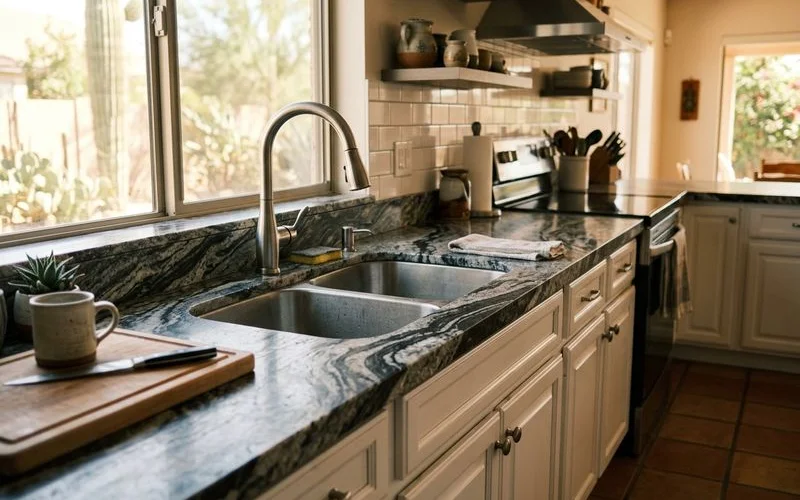
Granite appeals to buyers who want authentic, one-of-a-kind character. The natural mineral crystals, intricate veining, and deep color tones cannot be replicated by any engineered product. Each slab tells a geological story that you get to feature in your kitchen. You must visit the stone yard to hand-select your specific slab because showroom samples rarely match the final product perfectly.
Our designers note that this unpredictability is a tradeoff. You might love a small sample chip, but the actual slab could feature a drastically different color distribution.
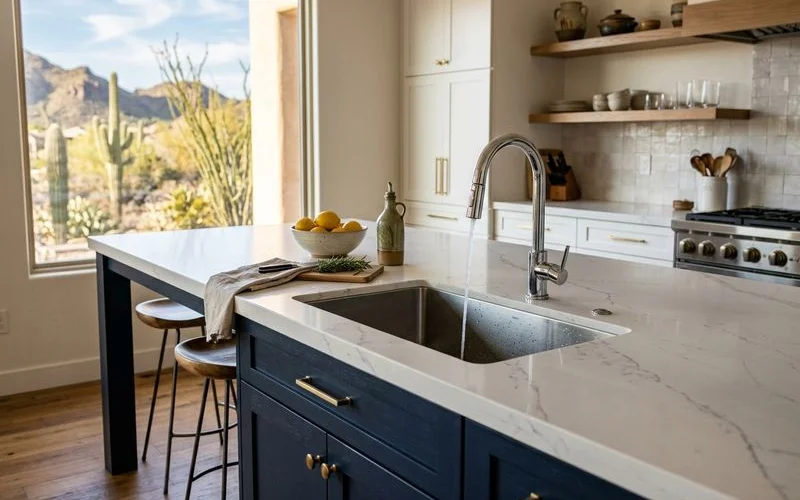
Quartz appeals to people who want a specific, guaranteed aesthetic. Modern quartz products convincingly mimic high-end materials. The consistency provides a massive design advantage because the installed countertop will match your showroom sample exactly.
Here are a few of the most popular engineered styles requested in 2026:
- Marble Mimics: Designs like Cambria’s Brittanicca offer the elegant look of white marble without the heavy maintenance.
- Industrial Concrete: Matte gray finishes provide a modern, urban aesthetic for contemporary kitchens.
- Pure Solids: Crisp, bright whites like Snowy Ibiza deliver a clean, minimalist vibe.
- Dark Drama: Charcoal and black bases with delicate white patterning create striking focal points.
We do warn clients about one minor visual drawback with engineered surfaces. Very large kitchen islands might reveal pattern repetition upon close inspection. Natural stone never repeats its pattern.
Durability and Maintenance
We know that a beautiful kitchen still needs to function as a highly active workspace. Both of these materials score extremely high on general durability metrics. Choosing the right one simply requires matching the stone’s specific strengths to your daily routine.
Let us compare how they handle the four most common kitchen hazards.
Heat Resistance
Granite wins the heat resistance category without question. Natural stone handles hot pots and pans directly from the stove without suffering any damage. In a busy Arizona kitchen where you pull scorching baking sheets from the oven, granite gives you the freedom to set them down anywhere.
Quartz is notoriously heat-sensitive. The polymer resins inside the engineered stone begin to break down and degrade at temperatures above 150 degrees Fahrenheit. A hot pan fresh from a 400-degree oven will cause permanent scorch marks, cracking, or discoloration.
Our installation crews always advise quartz owners to use silicone trivets or hot pads. This heat limitation is a meaningful factor for families who grill outdoors year-round. Hot platters moving between the patio grill and the indoor kitchen need a safe, heat-proof landing spot.
Stain Resistance
Quartz takes the top spot for stain resistance. The non-porous resin surface completely blocks liquids from absorbing into the material. Coffee, red wine, tomato sauce, and lemon juice wipe up easily without leaving a trace behind.
Granite is a naturally porous rock. Acidic liquids like citrus juice or vinegar can etch or stain the surface if you do not wipe them up promptly. Homeowners must apply a quality impregnating sealer, like Dry-Treat or Tenax, every one to two years to maintain this protection.
We find that most granite owners quickly develop the habit of wiping up spills immediately. In practical terms, sealed granite rarely suffers permanent stains if maintained properly.
Scratch Resistance
Both options provide incredibly hard surfaces that resist everyday scratching. Geologists rate granite slightly harder, placing it at a 7 on the Mohs hardness scale. Quartz follows closely with a rating between 6 and 7.
You can safely chop vegetables on either surface without damaging the stone. Our team strongly advises against this practice for a different reason. The hard stone will dull your expensive chef knives incredibly fast, so you should always use a proper cutting board.
Bacteria Resistance
Quartz holds a slight edge in general hygiene. The solid, non-porous resin surface provides no microscopic hiding places for bacteria to multiply. You never have to apply chemical sealers to keep it food-safe.
Granite contains microscopic pores that could theoretically harbor bacteria if left unsealed. Properly sealed natural stone is perfectly hygienic for all practical kitchen purposes. Regular cleaning with mild soap and warm water keeps both materials exceptionally safe.
Cost Comparison for Maricopa County
Pricing for these countertop materials includes the raw slab, custom fabrication, edge profiling, and final installation. The numbers remain quite competitive between the two categories.
We compiled the current typical installed pricing for the Phoenix metro area:
| Quality Level | Granite (Installed) | Quartz (Installed) |
|---|---|---|
| Entry-level | $40 to $60/sq ft | $50 to $70/sq ft |
| Mid-range | $60 to $90/sq ft | $70 to $100/sq ft |
| Premium | $90 to $150/sq ft | $100 to $150/sq ft |
Industry data from 2026 shows the average American kitchen requires about 55 square feet of countertop space. For a slightly smaller setup with 40 to 50 square feet, the total installation breaks down clearly.
- Granite Total: $2,400 to $4,500 installed
- Quartz Total: $3,000 to $5,000 installed
Our pricing analysis shows that granite generally runs 10 to 20 percent cheaper at the same quality tier. Rare or exotic natural slabs are the only exception, as these unique colors can easily exceed premium engineered pricing.
Edge Profiles
Fabricators can finish both materials with a variety of stylish edge profiles to match your home’s architecture. The edge you choose subtly impacts the total project cost.
- Eased Edge: This straight cut features a slight rounding for safety. It provides a clean, modern look and comes standard in most base pricing.
- Beveled Edge: A subtle angled cut adds depth and catches the light. This requires a small upcharge.
- Ogee Edge: This elegant S-curve profile creates a traditional, formal appearance. Expect a moderate upcharge for this detailed work.
- Waterfall Edge: The countertop material wraps completely over the side of an island and drops to the floor. This creates a stunning visual impact but adds a premium cost of $800 to $2,000 per island.
We note that complex profiles like the ogee cost slightly more to execute in natural stone. Granite requires slower, more careful routing to prevent the natural crystals from chipping during fabrication. Both materials support beautiful, customized edges.
Arizona-Specific Considerations
Our local environment introduces a few unique challenges that homeowners in other regions never face. The intense desert climate directly impacts how these materials perform over time.
Direct Sunlight Exposure
The harsh Arizona sun streaming through large, west-facing windows can permanently damage engineered stone. Prolonged ultraviolet exposure causes the polymer resins in quartz to yellow and fade. Granite is completely immune to UV damage, making it the safer choice for kitchens with skylights or massive picture windows. Standard indoor lighting never affects either material.
Hard Water Deposits
Phoenix municipal water is notoriously hard, frequently testing above 15 Grains Per Gallon. This high mineral content leaves stubborn white calcium deposits around your kitchen sink and faucet base. Both countertops will develop this chalky film. Quartz is slightly easier to maintain here because you can safely dissolve the deposits using a simple white vinegar wipe. Vinegar contains acid that will strip the protective sealer right off your natural granite, forcing you to use specialized stone cleaners instead.
Outdoor Kitchen Performance
If you are designing a backyard kitchen or a covered patio bar, natural stone is the undisputed champion. Granite easily endures intense heat, freezing winter nights, and direct solar radiation without flinching. Quartz manufacturers explicitly void their warranties if you install their products outdoors. The weather fluctuations will quickly warp and crack the resin binders.
Quartz vs Granite Countertops: Which Is Better for Arizona Kitchens?
We believe the final decision rests on how you prioritize maintenance, aesthetics, and your daily cooking style. Review these practical checklists to see which profile fits your household best.
Choose natural granite if:
- You want an authentic piece of geological history with 100% unique character.
- You frequently transfer hot roasting pans directly from the oven to the counter.
- You are building an outdoor living space or patio kitchen.
- Your interior counters receive hours of direct, intense sunlight.
- Keeping the total budget as low as possible is your primary goal.
Choose engineered quartz if:
- You demand a guaranteed color and pattern match across a large kitchen.
- You want to eliminate the chore of applying chemical sealers every year.
- You have a chaotic household and need an absolutely stain-proof surface.
- You love the luxurious look of Carrara marble but refuse to deal with its fragility.
- Your kitchen features standard indoor lighting without extreme UV exposure.
See Both Materials in Your Kitchen
Answering the question of quartz vs granite countertops: which is better for Arizona kitchens? requires seeing the materials in person. You need to see how the surface interacts with your specific cabinet colors and under your exact lighting conditions. Zona Floors brings a full showroom of options directly to your living room during our free consultation process.
We handle every single step of your project, from the initial slab selection to the final precise installation. You will receive a smooth and professional remodel experience from start to finish.
Schedule your free kitchen consultation or call 480-428-5080.

Daniel Porter
Sales Manager, Zona Floors
Daniel Porter manages sales and client consultations at Zona Floors in Tempe, Arizona. He specializes in helping homeowners choose the right flooring materials through personalized in-home consultations across the Greater Phoenix area.
Certified Flooring Consultant · Bilingual (English/Spanish)
Looking for professional help?
Learn about our Kitchen Flooring service →